Ehsaas Labour Program 2026: Complete Registration & Eligibility Guide
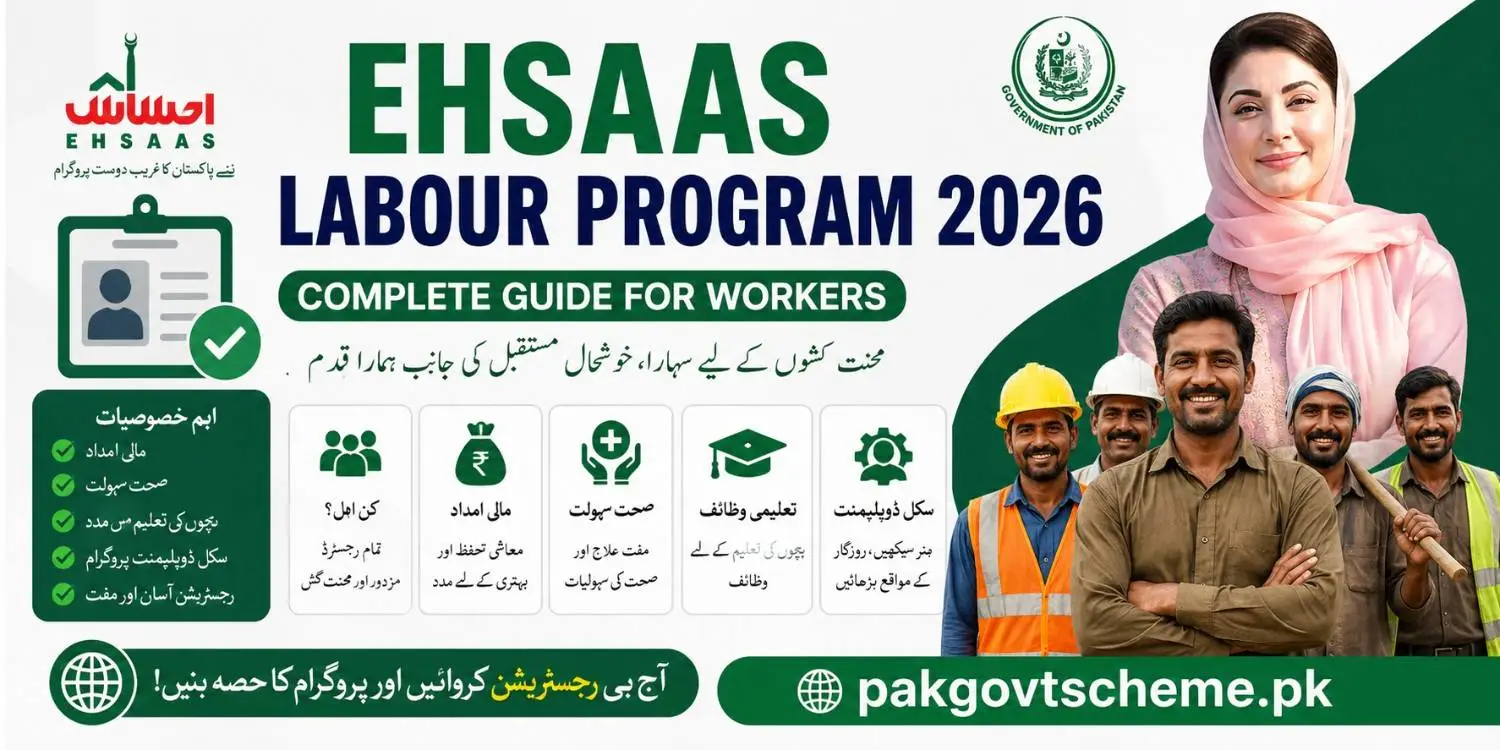
The Ehsaas Labour Program 2026 (also called Mazdoor Ka Ehsaas Program) is a government-backed scheme designed to provide financial relief, health coverage, and social protection to Pakistan’s informal workforce including rickshaw drivers, construction workers, domestic helpers, and street vendors. It is part of the broader Benazir Income Support Program (BISP) framework.
Also read: Rahmat Card 2026 Online Registration & Eligibility Guide
Quick Summary Table
| Feature | Details |
|---|---|
| Target Group | Daily wage earners, rickshaw drivers, construction workers, domestic helpers, street vendors |
| Cash Assistance | Rs. 13,500–16,000 quarterly |
| Verification | CNIC-linked biometric thumbprint |
| Additional Benefits | Free health insurance, digital wallet integration |
| Payment Method | Direct transfer to mobile wallets or bank accounts |
| Priority Groups | Widows, orphans, persons with disabilities |
| Coverage | Nationwide (Punjab, Sindh, KPK, Balochistan) |
what is Ehsaas Labour Program 2026?
The Ehsaas Labour Program 2026 is a government welfare initiative in Pakistan aimed at supporting the country’s informal workforce daily wage earners, rickshaw drivers, construction workers, domestic helpers, and street vendors. It was launched under the broader Ehsaas and BISP framework to provide financial relief and social protection to those who are most vulnerable.
Key Highlights
- Quarterly Cash Assistance: Eligible workers receive Rs. 13,500–16,000 every quarter.
- Biometric Verification: Payments are secured through CNIC-linked thumbprint verification.
- Health Insurance: Free emergency medical treatment is included for workers and their families.
- Digital Transparency: Registration and eligibility checks are done via the 8171 portal.
- Target Group: Informal workers who earn below a certain income threshold and do not own significant assets.
Key Features
- Quarterly Cash Assistance: Rs. 13,500–16,000 directly transferred to mobile wallets or bank accounts.
- Biometric Verification: Payments released only after CNIC-linked thumbprint verification.
- Health Insurance: Free emergency medical treatment through integrated health cards.
- Digital Transparency: Registration and eligibility checks via the 8171 web portal.
- Nationwide Coverage: Available across Punjab, Sindh, KPK, and Balochistan.
Eligibility Criteria
- Income Threshold: Household income below Rs. 32,000–40,000.
- Employment Status: Daily wagers or informal workers (non-salaried).
- Asset Restrictions: No ownership of cars or more than 2 acres of agricultural land.
- Social Priority: Widows, orphans, and persons with disabilities are prioritized.
- PMT Score: Must be below 32 in the Dynamic Survey 2026.
Registration Process
- SMS Method: Send CNIC number to 8171.
- Web Portal: Visit the official 8171 portal and enter CNIC details.
- Verification: NADRA and NSER databases cross-check eligibility.
- Biometric Confirmation: Thumbprint verification at designated centers.
- Activation: Eligible applicants receive funds directly in wallets.
Benefits for Families
- Financial Stability: Regular stipends reduce vulnerability to inflation.
- Healthcare Access: Emergency medical coverage for workers and families.
- Social Protection: Safety net for marginalized groups.
- Digital Inclusion: Encourages mobile banking and financial literacy.
FAQs
Q1: How can I check eligibility for the Ehsaas Labour Program?
A1: Send your CNIC to 8171 or check via the official portal.
Q2: What documents are required?
A2: Valid CNIC, proof of informal employment, and biometric verification.
Q3: Can government employees apply?
A3: No, only informal workers are eligible.
Q4: Is the program free to register?
A4: Yes, there is no application fee.
Q5: How often are payments made?
A5: Quarterly installments are disbursed directly to wallets.
Conclusion
The Ehsaas Labour Program 2026 is more than just a financial aid scheme it is a social safety net designed to uplift Pakistan’s most vulnerable workforce. By offering quarterly stipends, health insurance, and digital transparency through the 8171 portal, the program ensures that daily wage earners and informal workers are not left behind in the country’s economic progress.
For millions of rickshaw drivers, construction workers, domestic helpers, and street vendors, this initiative provides stability, dignity, and hope. It bridges the gap between poverty and opportunity, while also promoting financial inclusion through mobile wallets and biometric verification.